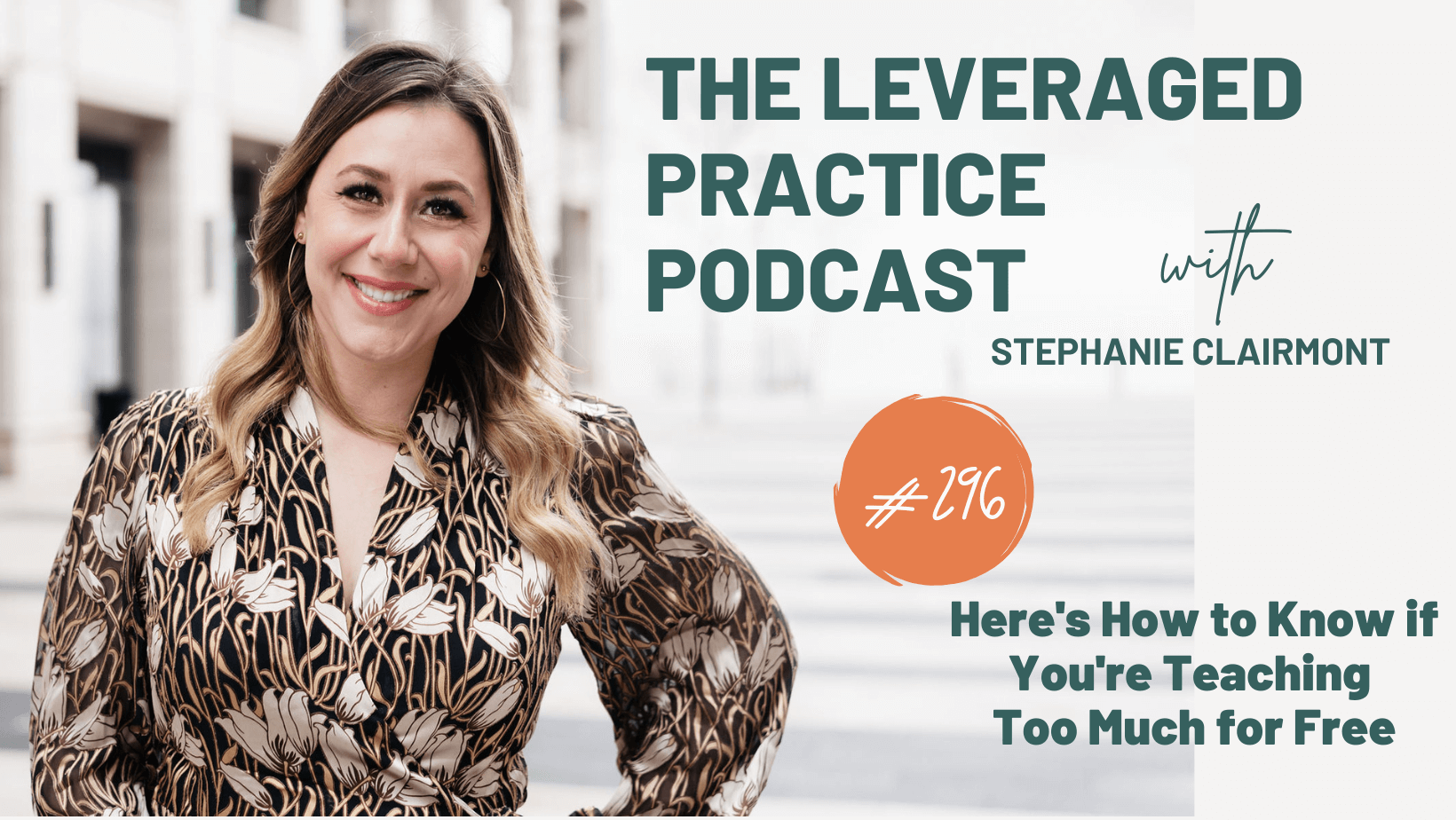
Ep. 296 Here’s How to Know if You’re Teaching Too Much for Free
Listen on your favourite podcast app like Apple Podcasts or Spotify.
If you have been creating content for your health practice, whether it is blog posts, podcasts, videos, or social media, and you are still not seeing enough sales from your programs, courses, or memberships, there is a common mistake you might be making: you are giving away too much for free.
This is one of the biggest challenges health professionals face when they step into the world of online education. As natural teachers and helpers, it is easy to share everything you know in hopes of building trust. But without a strategic content plan, your generosity might actually be stopping people from working with you.
In this article, we will cover:
- Why health professionals tend to over-teach
- The difference between free and paid content
- How to spot when you are giving away too much
- The role of “stepping stone” content in your marketing
- How to structure your offers to attract and convert clients
Why Health Professionals Give Away Too Much for Free
Whether you are a dietitian, speech language pathologist, physiotherapist, naturopath, physician, nurse, or therapist, you have likely entered your profession because you genuinely want to help people. Teaching comes naturally to you, it is part of your training and your daily work.
That is why, when you start creating online content, it feels natural to share recipes, tips, scripts, exercises, and strategies. You want people to walk away with something useful.
The problem is, when you give away full solutions in your free content, your audience feels like they already got the answer they needed. They do not see why they would hire you or join your program, because you have already told them what to do.
The Difference Between Free and Paid Content
Not all free content is bad. In fact, it is essential for building awareness and trust. The key is understanding the difference between content that attracts clients and content that replaces your paid work.
I call this “stepping stone content.” Stepping stone content is a small, strategic sample of your work that moves your ideal client closer to saying “yes” to working with you. It is designed to help them take one small step forward, not to solve their entire problem.
Here is what that looks like in practice:
- Free content: Strategic samples that build trust and interest in your paid offers. Examples include a podcast episode discussing common mistakes, an Instagram post raising awareness about a problem, or a downloadable guide that helps them identify their starting point.
- Paid content: Your full process, tools, and implementation support. This could be a low ticket product under $50, a self study course, a group program, or your signature offer.
When free content crosses into paid content territory, giving people a plan, checklist, or full solution, you lose the natural motivation for them to work with you.
Signs You Are Giving Away Too Much for Free
Here is how to know if your free content is actually hurting your sales:
1. Your content gives an action plan
If someone can read your blog, listen to your podcast, or follow you on Instagram and walk away with exactly what to do to solve their problem, you have crossed the line from sample to full solution.
For example:
- A meal plan with recipes and grocery lists for people with IBS
- A complete set of exercises to fix back pain
- A script for having a difficult conversation with a spouse
- A checklist for managing a specific mental health challenge
If your content answers their question in full, they may not see why they need your program.
2. You are giving away your “what to do” for free
When someone hires you, they often think they are paying for the “what to do.” But the real value you bring includes helping them understand why they need to do it, personalizing it to their situation, and supporting them through implementation.
If your free content focuses too heavily on the “what to do,” you are giving away the part they think they are paying for, without showing the rest of the path.
3. You are acting like a blogger or content creator
If you have slipped into the role of “content creator” instead of “business owner,” you might be creating free content just for the sake of creating content, like a blogger or influencer does. Content creators make money from ads, brand deals, and sponsorships. Health business owners make money from selling their own programs, products, and services.
If your strategy looks more like a blogger’s than a business owner’s, it is time to refocus.
Why a Strategic Content Plan Matters
Free content should have one main purpose, to move your ideal client closer to working with you.
That is why I recommend structuring your marketing around a scalable product suite that includes:
- Free Lead Magnet – A downloadable guide, checklist, or resource that grows your email list and gives a taste of your expertise without giving away your full solution.
- Low Ticket Offer – A paid product under $50 that provides more value than your free content, but still leaves room for your core program.
- Core Offer – Your main program, course, or membership where you deliver your complete process and support.
With this structure, your content becomes intentional. Every free piece you create leads toward your lead magnet, which leads to your low ticket offer, which naturally leads into your core program.
The Power of Stepping Stone Content
Think of your content as stepping stones across a river. Your audience is standing on one side with a problem they want solved. Your job is to place the right stones so they can cross to the other side, where your paid offer is waiting.
The wrong way: Give them a bridge in the form of a complete solution in your free content. They cross without ever hiring you.
The right way: Give them the first few stones so they can take a step forward, see the value you provide, and realize they need your program to get to the other side.
My Experience With Over Teaching
When I started my career as an entrepreneurial dietitian in digestive health and IBS, I built a strong reputation online. I was a well known international blogger, created a lot of free content, and grew a large email list.
I gave away recipes, tips, supplement recommendations, and even full meal plans. My traffic numbers were impressive, thousands of new subscribers every month, but I struggled to make consistent sales from my programs.
It was not until I learned to pull back, create strategic stepping stone content, and build a proper product suite that I started selling programs every single day. My system looked like this:
- A free guide as my lead magnet
- A $20 ebook as my low ticket offer
- My signature IBS program as my core offer
This combination allowed people to sample my work, invest in a small product, and then naturally move into my higher value program.
How to Adjust Your Content Strategy Today
If you suspect you are over teaching, here is how to start fixing it:
1. Audit your existing content
Look at your blog posts, podcast episodes, videos, and freebies. Are you giving away full solutions or action plans? Are you providing the “what to do” without showing the rest of the path?
2. Create a content filter
Before publishing anything, ask:
- Am I giving them an action plan?
- Does this content solve their problem completely?
- Is this information better suited for a paid offer?
3. Shift your free content to problem awareness
Instead of telling people exactly what to do, focus on helping them understand:
- Why the problem is happening
- What mistakes to avoid
- What is possible if they solve it
- What the first small step looks like
4. Link your free content to your product suite
Make sure every piece of content leads to your lead magnet, which leads to your low ticket offer, which leads to your core program.
Building Your Strategic Roadmap
A strategic content plan does not just protect your paid work, it increases your sales. By intentionally guiding people from free to low ticket to core offer, you give them a reason to keep moving forward with you.
This is exactly what we will be building in the Build Your Digital Practice Bootcamp. In this live, week long training, you will:
- Create your free lead magnet that attracts the right audience
- Design your low ticket product under $50 that sells daily
- Map out your core offer and how it all connects
When you have this roadmap in place, you stop over teaching, start attracting better leads, and make more consistent sales.
Ready to stop giving away too much for free and start building a scalable, profitable online practice?
Join me for the Build Your Digital Practice Bootcamp, registration is 50% off right now, just $48.
Click here to save your spot
To your business fulfillment and success,
Stephanie Clairmont, MHSc
Online Business Strategist
If you enjoyed this episode, you might also enjoy:
- Ep. 293 The Secrets of a Low Price Point Educational Product
- Ep. 294 Do This Before You Run Ads
- Ep. 295 The Difference Between Free and Paid Content