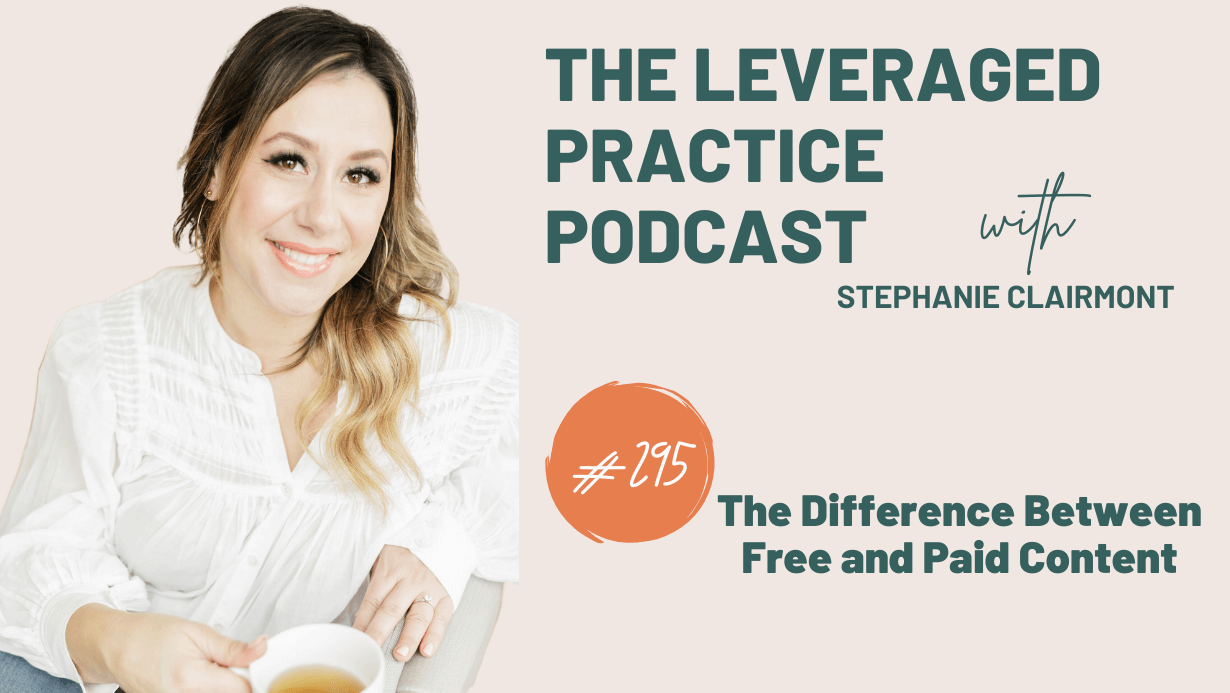
Ep. 295 The Difference Between Free and Paid Content
Listen on your favourite podcast app like Apple Podcasts or Spotify.
If you’re a health professional ready to grow your digital practice, one of the most important concepts you need to grasp is the difference between your free and paid content.
This is one of the most common questions I get from my clients, especially when they start creating their lead generation strategy, using a lead magnet to get potential clients into their world.
Whether you have a freebie or lead magnet out in the world now, have your online program ready to market or are getting started with all of this, you’re going to appreciate this article.
Here’s the key…
Understanding this difference is not just about knowing what to give away for free and what to charge for. It’s about strategically structuring your offers so that each piece of content moves your audience closer to becoming a client without overwhelming them or giving away the farm.
Let’s break it down.
Why This Question Comes Up So Often
When most health professionals start building an online business, they jump right into content creation because that’s what we’ve been told to do. Post on Instagram. Start a podcast. Write blog posts. Share value.
But without a clear strategy, you can find yourself wondering:
“What’s the actual difference between the content I give away for free… and what people should pay for?”
That question becomes even more confusing when you’re creating multiple offers like an $18 ebook, a $49 workshop, or a core online program. It can feel overwhelming trying to figure out what goes where.
Your Online Business Needs These 3 Core Offers
At The Leverage Practice, we teach our clients how to build a scalable online business using what we call a 3-Piece Scalable Offer Suite:
- Free Content – Builds trust and nurtures new leads.
- Low Ticket Paid Product – Offers a small win and leads to your core offer.
- Core Program – The high-value signature program that delivers your full methodology.
These three components are not “nice-to-haves”, they are essential. Whether you’re just starting or already have a program you want to sell more of, these three steps guide your ideal clients through a powerful journey, from discovery to transformation.
What Counts as Free Content?
There are two categories of free content:
1. Light, Short-Form Content (Social Media)
This includes Reels, posts, stories, and quick tips that highlight problems and desires but don’t go deep into education. This is your “fluffy” content. It helps build awareness and visibility.
2. Deeper, Strategic Freebies (Lead Magnets)
These are opt-in resources like guides or free classes that are more strategic and focused. At The Leverage Practice, we teach two types of lead magnets:
- Guide-Style Freebies: PDFs, checklists, or simple workbooks.
- Free Class-Style Freebies: Short webinars or video training.
These assets aren’t just freebies, they are strategic entry points into your world. Their job isn’t to teach your full methodology but to help your audience understand what’s missing, where they’re going wrong, and what steps to take next. They create trust and clarity while setting up your paid offers.
What Should Be Paid Content?
Now here’s where it gets important.
Your paid content includes any online educational offer where someone exchanges money for access. This can include:
- Downloadable ebooks
- Paid toolkits or workbooks
- Audio or video self-study courses
- Group programs
- Live or hybrid coaching programs
- Workshops or intensives
The main difference between free and paid content is this:
Paid content teaches strategy and helps with implementation. Free content raises awareness and inspires action.
A Real-World Example from My Practice
Let’s rewind to 2013 when I was known globally as The IBS Dietitian. I saw clients one-on-one three days a week, but I knew I had more to offer. So I wrote a book: The IBS Master Plan, which became the first FODMAP-based book available in North America.
Initially, it sold on Amazon for $50—but I only made $1 per sale. So I converted it to a digital ebook, dropped the price to $18, and sold it on my website. That simple change let me keep 100% of the revenue and reach more people who couldn’t afford private sessions or who lived outside my licensing jurisdiction.
People started emailing me saying, “My symptoms are gone—just from the book.” That was the power of a well-designed low-ticket paid product.
Even more interesting?
Some people who bought the ebook ended up buying my core IBS program. I didn’t have to hop on a call or message them in the DMs. The ebook gave them a taste of my work—and they wanted more.
Your Core Program Is Still the Goal
Your core offer is where your full methodology lives. It leads clients step-by-step through a proven process. Whether it’s six weeks or six months, it includes:
- Curriculum
- Implementation support
- Coaching or community access
- Exercises or tools that drive real results
It’s the highest value offer in your business and it’s where you make the biggest transformation for your clients.
Every other piece of content you create, free or low-ticket, should naturally lead people toward this core offer.
So… What’s the Actual Difference Between Free and Paid Content?
Let’s simplify the distinction.
Free content falls into two categories: the light, bite-sized content you share on platforms like Instagram or TikTok, and your more strategic long-form content like a guide or a free class. The light content helps raise awareness, it’s short, engaging, and speaks to your audience’s problems and desires without offering much depth. Your strategic free content, like a downloadable guide or webinar, goes a bit deeper. It helps people understand what’s missing in their current approach and builds trust by positioning you as the expert who “gets it.” But it stops short of teaching full strategies or guiding them through implementation.
Paid content, on the other hand, includes any offer that teaches a strategy, helps people implement, or delivers an actual transformation. That includes ebooks, toolkits, workshops, self-study courses, and your full core program. The biggest difference is that paid content helps someone do the work. It takes them beyond awareness and into action. These offers may include curriculum, exercises, or even support from you, like coaching calls, Q&A, or community access. And the higher the investment, the more comprehensive the support and transformation.
Put simply, free content builds belief and trust, while paid content delivers action and results. The more implementation help, structure, or support you include, the more valuable it is and the more you should charge.
Why Many Health Professionals Get This Wrong
This is one of the biggest mistakes I see in our industry:
Health professionals are giving away way too much for free! Often because they’ve seen others do it or followed generic business advice that doesn’t understand our field.
You are trained, licensed, and experienced in a helping profession. Your content should reflect that level of expertise—and be positioned as valuable.
Free content is for belief-shifting, educating, and trust-building.
Paid content is for implementing, solving problems, and transformation.
The Power of a Scalable Offer Suite
Here’s the beautiful part: when your free, low-ticket, and core offers are strategically linked…
- Your freebie builds belief and awareness.
- Your low-ticket offer provides a quick win and establishes trust.
- Your core offer delivers the transformation.
This system works together like a well-oiled machine—and it allows you to help more people, earn more revenue, and build a sustainable online business.
We call this your Scalable Offer Suite and if you’re missing even one piece, your sales will suffer.
Join the Build Your Digital Practice Bootcamp
If this blog post hits home, you need to join us for the Build Your Digital Practice Bootcamp, happening August 25 to 29.
What you’ll learn:
- How to design your 3-piece scalable offer suite
- The exact difference between free and paid content in health education
- What to include in each offer
- How to build a simple roadmap to online business success
This 5-day bootcamp is currently 50% off – just $48. You’ll get live training sessions, a fill-in-the-blanks roadmap, and optional VIP access for Q&A and feedback.
Final Thoughts
Your content strategy is the foundation of your digital health practice. When you clearly understand what’s free, what’s paid, and how it all works together, you’ll stop second-guessing every post, every freebie, every offer.
You’ll have a business that flows.
You’ll attract aligned clients.
And you’ll finally get paid for your knowledge—without burnout.
Let’s build it together.
Stephanie
If you enjoyed this episode, you might also enjoy:
- Ep. 292 Make Sales Every Day into Your Health Programs with These Funnels
- Ep. 293 The Secrets of a Low Price Point Educational Product
- Ep. 294 Do This Before You Run Ads