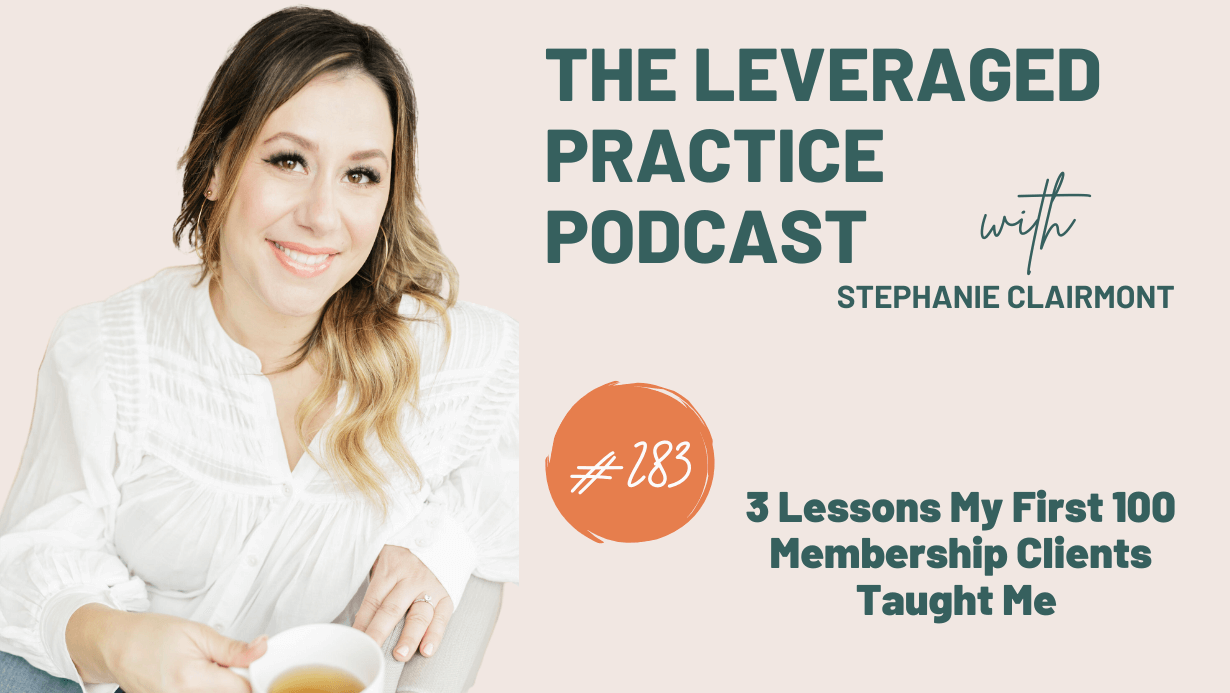
Ep. 283 3 Lessons My First 100 Membership Clients Taught Me
Listen on your favourite podcast app like Apple Podcasts or Spotify.
Storytelling is an important skill, and I’ve been working on becoming a better storyteller. If you’ve been under a rock, then you might not know this—but storytelling is an essential part of growing an online business in today’s market. If you’re an expert in your field and you’re not learning how to be a better marketer, a better sharer of your work, and a better storyteller, then you’re going to struggle.
So today, I want to share a story with you—one that takes me back to 2016, when I launched my very first membership as an IBS dietitian. This was a big shift for me in my business, and I learned three powerful lessons that I know will be incredibly helpful for you as you build, launch, and grow your own programs, courses, and memberships.
Lesson #1: A Price Increase is One of the Best Launch Strategies You Can Use
In October of 2016, I officially launched my first-ever membership. At the time, I had an established private practice, an online presence, a solid email list, and a well-trafficked blog getting 40,000 visitors a month. I had spent years helping people with digestive health and IBS through one-on-one coaching, self-study courses, and hybrid programs. But I saw a gap in the market—people with IBS still needed help after completing a structured program. They weren’t just magically “cured” in 12 weeks.
So I decided to create a membership program where they could continue to get support. And I went all in.
Here’s how I launched:
- The membership was $9.99/month for the first wave of members.
- After the first weekend, the price doubled to $19.99/month.
- Over that three-day launch, 101 people signed up.
Why did this work so well? Because a limited-time lower price gives people a clear financial reason to join now rather than later. And the truth is, $9.99 was way too low for what I was offering (I’ll get to that next). But what mattered was that I got people in the door, built momentum, and proved the demand for my membership.
So whether you’re launching a course, a group program, or a membership, this pricing strategy works. I teach it to my clients now, and it’s been successful time and time again.
Lesson #2: Overdelivering Will Burn You Out So Keep Your Offer Simple
Let’s talk about what I promised inside that membership.
Here’s what I thought was a “great idea” at the time:
- A weekly Q&A with me
- A weekly cooking demonstration
- 10 brand-new recipes per month (which required recipe development, photography, and meal prep)
- A new course every month
- A community where I answered questions daily
This was a ton of work for a $9.99/month membership. I was doing too much.
I quickly realized that if I wanted my membership to be sustainable, I needed to simplify the deliverables. After the first month, I told my members:
“Hey, I overpromised here. I’m still giving you the courses, the recipes, and the Q&A calls, but I can’t do the cooking demos at this pace. If you want to cancel, no worries.”
And guess what? Almost nobody left. Because most people weren’t even using everything I had packed into the membership.
What I learned—and what I still teach today—is that simpler is better. People don’t want more content. They want results. The right amount of content to get them from Point A to Point B is what matters.
If you’re planning a course, program, or membership, don’t make the mistake I did. Start with less. You can always add more later.
Lesson #3: Not All Software Can Handle What You Need
I initially launched my membership on Thinkific because it was a course platform, and at the time, it seemed like the best option.
It was not the best option.
The community experience wasn’t great. The navigation was clunky. And within the first week, I knew I had to switch.
So I started customizing a software solution, pulling together multiple tools to create a better experience for my members. It was a lot of work.
And that’s why, today, I always tell my clients to be intentional about the software they use.
Your platform matters because it affects how easily people can engage with your content, ask questions, and stay subscribed. If your course or membership feels clunky or disconnected, people will leave—not because your content isn’t good, but because they don’t feel supported in the experience.
This is actually why, in my current business, we built and licensed our own platform—so my clients could have a seamless, all-in-one system to create, sell, and deliver their online programs without having to piece together a million tools.
If you’re launching a program, don’t just pick the cheapest or most popular software. Make sure it actually supports the experience you want to create.
Fast-Forward to Today…
That first membership was a huge learning experience. I scaled it to 250 members in five months, continued to grow from there, and eventually moved on to bigger programs and offers.
Now, nearly 10 years later, I’ve built a multi-six-figure business helping other health professionals and service providers do the same thing—grow successful online programs that help more people without burning out.
And just recently, I launched another membership—the Healthcare Impact Academy—using everything I learned from my first experience:
- A pricing structure that makes sense
- A streamlined, simple offer that delivers results without overwhelming me or my members
- The right software to support an amazing user experience
If you’re a health professional or service provider who wants to leverage your expertise into an online program, you can check it out at HealthcareImpactAcademy.com.
Or, if you’re still in the early stages and want to see the exact strategy I use to cut back my work hours while growing my income, I’d love to have you in my free upcoming masterclass.
Register Here for the Free Masterclass
Final Thoughts If you’re thinking about launching a membership, a course, or any kind of online offer, I hope these lessons help:
- Use price increases to drive action in your launch.
- Don’t overcomplicate your program—people don’t need more, they need results.
- Make sure your software can support the experience you want to create.
And most importantly? Just start. You don’t have to have it all figured out. You can adjust, tweak, and optimize as you go. That’s exactly what I did, and it led me to a business that I love—one that lets me help more people, work less, and make money differently.
Let me know—did this story help? DM me on Instagram and tell me what your biggest takeaway was.
I’ll see you in the next one.
Much love,
Stephanie
If you enjoyed this episode, you might also enjoy:
- Ep. 280 I’m Flipping this Company Upside Down – Here’s Why
- Ep. 281 Introducing Healthcare Impact Academy Membership
- Ep. 282 Does Your Practice Need a Passive Income Product Suite?