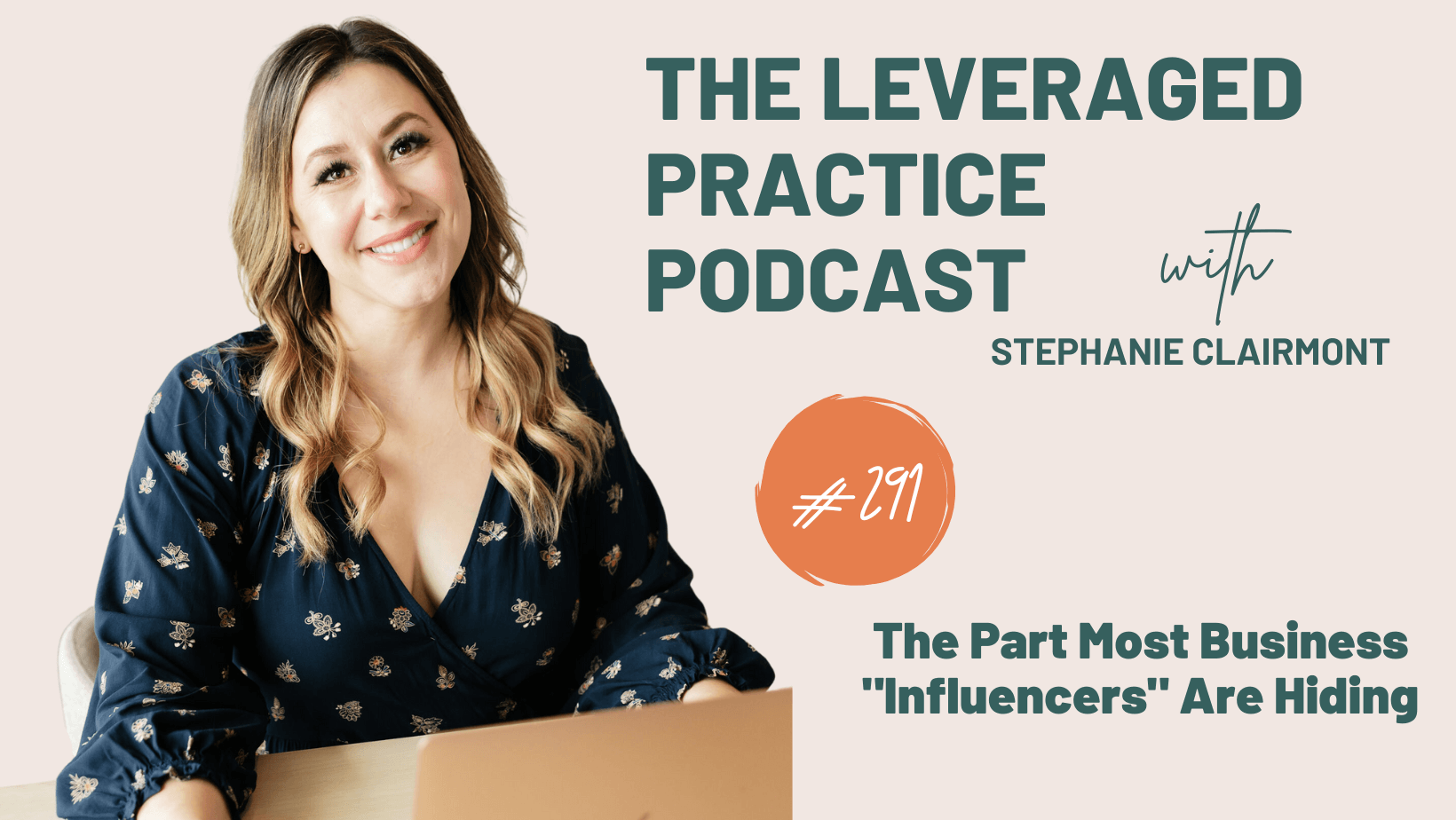
Ep. 291 The Part Most Business “Influencers” Are Hiding
Listen on your favourite podcast app like Apple Podcasts or Spotify.
In the age of Instagram reels, viral ads, and carousel posts filled with success stats, there’s a new persona rising in the online business space: the business influencer. They’re not just entrepreneurs. They’re personalities. They share their behind-the-scenes, their wins, their milestones, and often, their revenue. They’re entertaining, persuasive, and often look wildly successful.
But there’s something many of them aren’t showing you.
A New Breed of Online Leader
Since 2020, the business influencer archetype has exploded. These are individuals who built a following quickly, often sharing dramatic success stories—retiring their partners, hitting six or seven figures in a year, growing audiences of 100K+ seemingly overnight. And if you’re a business owner building something more sustainably, it can feel like you’re falling behind.
Here’s the truth: you’re not. But you might be comparing yourself to someone who isn’t telling you the full story.
Behind the Curtain: Sensationalized Success
Let’s address the elephant in the room: a lot of what you see online is sensationalized. Not always maliciously, but curated in a way that emphasizes the result while omitting the real work—and investment—it took to get there.
There are people claiming to scale to six figures with a “$5/day ad strategy,” when inside their courses or private trainings, they admit to spending $100/day or more. That’s a bait-and-switch. It’s not just misleading—it’s damaging to entrepreneurs who are following along in good faith, wondering why they’re not seeing the same results with a fraction of the budget.
And it’s not just ad spend. We rarely see:
- The number of hours these individuals are working
- The size of their teams
- Their total operating expenses
- Their actual profit margins
It’s easy to look at a milestone like “seven figures” and assume it’s pure revenue in the bank, but in some cases, those figures come with hundreds of thousands in ad costs, bloated teams, and barely sustainable workloads.
I once heard someone speak on stage about generating $1.2 million in revenue. Later, they mentioned—almost by accident—that their ad spend that year was $850,000. Do the math. With a physical office space and a team, that “million-dollar business” likely netted them less than many smaller businesses with better margins and far less overhead.
The Hustle No One Brags About
There’s also what I call invisible effort: the extreme work hours people don’t showcase.
Back when I launched my first membership in 2016, I had a friend doing something similar. We hit 100 members at roughly the same time, and both grew steadily to 150. But where our paths diverged was in our work styles. She regularly worked 14 to 17 hours a day. I was pregnant at the time, balancing family life and my business. She grew faster, yes—but at the cost of her time, health, and eventually, burnout.
That’s the trade-off you don’t always see. When someone is publishing content daily, growing at lightning speed, or launching back-to-back offers—it’s often fueled by relentless hours and personal sacrifice. And if that’s not how you want to build your business, that’s okay.
But don’t compare your pace to theirs without also comparing the price they’re paying.
Comparison Creeps In Quietly
Even when we know better, it’s easy for that creeping sense of inadequacy to sneak in.
You scroll Instagram to post your reel and suddenly you’re staring at someone else’s launch celebration, someone else’s sales milestone, someone else’s highlight reel. And a quiet voice asks, Why am I not there yet?
It’s subtle, but persistent. You don’t feel like you’re comparing yourself—but your brain starts building a story that maybe you’re doing something wrong, maybe you’re behind, maybe success isn’t meant for you.
You’re not behind. And you’re not doing it wrong.
You’re building something real. And that takes time.
What Building a Real Business Actually Looks Like
The truth is—growth is slow. Business takes time. It requires strategy, yes, but also patience.
Here’s what’s really involved:
- Creating lead magnets that actually attract the right people
- Learning what messaging resonates with your audience
- Developing the right offers, at the right price points
- Testing, tweaking, launching, and relaunching until things start to click
- Navigating real life—kids, aging parents, personal health, practice responsibilities—while building your brand
None of that is fast. None of that is easy. And none of it is what gets shouted from rooftops on social media.
But that’s the reality for most business owners building something with depth and staying power.
Don’t Let the Highlights Become Your Benchmark
We’re in a time where everyone is talking about their revenue. About hanging out by the pool while the sales roll in. About the “ease” of their business model.
But what’s missing from that narrative is context.
Maybe they’re spending more on ads than they’re earning. Maybe they’ve been in business for five years and are just now breaking through. Maybe they’ve built an audience that follows them—but doesn’t buy from them. Maybe their personal life is suffering under the weight of the hustle.
You don’t know what you can’t see.
So don’t make assumptions. And don’t let other people’s carefully curated timelines become the benchmark for your own progress.
You’re Probably Doing a Lot More Right Than You Realize
If you’re here, reading this, you’re probably already doing a lot of the right things.
You’ve created a lead magnet.
You’re sending emails.
You’re showing up on social.
You’re refining your message.
You’re building the systems.
You’re making sales—even if it’s slower than you’d like.
That’s what growth looks like. And it’s okay if it’s not flashy or fast.
Sometimes it’s about adjusting your funnel. Sometimes it’s about improving your messaging. Sometimes it’s just about giving it more time.
That doesn’t mean you’re failing. It means you’re building something real.
It’s Okay to Unfollow the Noise
One of the simplest ways to protect your mindset is to curate your environment.
If certain accounts, ads, or newsletters make you feel inadequate or behind, mute them. Unsubscribe. Hit “hide this ad.” You don’t owe anyone your attention—especially if their content chips away at your confidence.
Instead, surround yourself with people who are transparent about the time, energy, and effort it takes to succeed. Look for business leaders who don’t glamorize hustle culture or oversimplify results. People like Alex Hormozi and Russell Brunson are great examples of this—high-performing entrepreneurs who still talk honestly about what goes into their success.
They work hard. Really hard. But they’re not hiding that from you.
This Is Why I Built a Membership Model
All of this is exactly why I restructured my business. We used to sell courses for hundreds or even thousands of dollars. But I saw how long it really took people to implement the strategies and build sustainable systems.
So now, everything is inside Healthcare Impact Academy—our monthly membership for health entrepreneurs who want to build online programs, digital products, and lead-generating content at a pace that actually works for real life.
Because business takes time. And I wanted to create a model that supported that truth.
If you’re looking for help building out your product suite, improving your funnels, or simply staying on track while life happens around you, you can learn more at healthcareimpactacademy.com.
You’re Not Behind
Let me leave you with this:
You are not behind.
You are not broken.
You are not failing.
You are showing up.
You are doing the work.
You are learning.
You are building.
That’s what business looks like. That’s what success looks like. Don’t let curated content convince you otherwise.
So keep going. Stay the course. Trust your process.
You’ve got this.
If you enjoyed this episode, you might also enjoy:
- Ep. 288 Why I’ve Been MIA & Growing Your Business Profitably
- Ep. 289 Is Free Stuff Still Working to Get Clients Signed Up for Your Programs?
- Ep. 290 Do You Need Sales Calls for Online Programs & Courses?