Ep. 234 Which Type of Program is Best for My Private Practice?
Listen on your favourite podcast app like Apple Podcasts or Spotify.
Navigating the digital landscape as a healthcare professional? Take a moment to tune into this comprehensive guide where our host Stephanie Clairmont sheds light on the four proven models for online programs: High-Touch Hybrid, Small Group Cohort, Group Program, and Maintenance Membership. Stephanie’s struggles with seasonal depression inspired her to adopt a unique approach to healthcare education programs, and she’s dedicated this episode to sharing her experiences to help you choose the best model for your business.
Deciding on the best model is just the first step. She dives deeper into discussing long-term goals and how to test your content to ensure the best results. Whether you’re just starting out or looking to refine your existing program, you’ll find this insight into the strategic aspects of program design invaluable.
The final part of today’s discussion focuses on the key components that make an online program successful. Stephanie discusses everything from content to marketing strategy and how to resonate with your target audience. Leveraging key tools and resources is vital to your success, and this episode provides you with actionable strategies to make it happen.
Join us for our FREE 5-Day Workshop: Find Freedom with eLearning
Happening September 11-15 at 1:00pm – 2:00pm EDT
In this free workshop, you’ll learn how to leverage your expertise to offer programs & courses to your clientele so you can have more financial and time freedom with your private practice.
Go to LeverageYourPractice.com to register!
Key Topics:
- Intro to Topic – Which Type of Program is Best for My Private Practice? (03:49)
- The Four Models of Online Programs and Which to Pick (05:43)
- Going Deeper into The Four Models (08:14)
- Which is Usually the Best First Version of a Program (13:19)
- What Do You Want Your Life to Look Like in Thee Years (15:36)
- It’s Not Just About You, But About the People (17:27)
- Looking at the Market Need and Gap (19:58)
If you enjoyed this episode, you might also enjoy:
- Ep. 225 How to Launch a Group Program
- Ep. 232 Do I Need an Online Presence to Launch a Digital Program?
From Confusion to Clarity: Choosing the Online Program Model for Your Health Practice
Hey there, fellow health professionals, practitioners, clinicians and private practice owners.
Contemplating about building your practice beyond one-to-one appointments? Or, have an existing online course, but don’t know how to effectively launch and/or market it? Or, working (have worked) with another coach to build out a digital program and…
- it’s not quite feeling right?
- not quite doing what you want it to?
- not enough people signing up?
That’s perfectly okay. Just means it’s a wrong fit. Either your chosen online course modality and/or launch, marketing strategy and/or coach. We are here to help you reconnect and discover the program model that will truly leverage your health practice.
Well, glad you made it here. Here at The Leveraged Practice, it’s what we do best. We help health professionals and private practice owners develop digital assets to compliment their existing health practices.
We leverage your digital assets by teaching up-to-date marketing strategies and tools, and provide an all-in-one TLP Tech software. We do all of this, to help you reach and impact the lives of more beautiful humans with your digital programs. Awesome, right?
Today’s conversation is geared towards those who are considering or already developed a digital program for their health practice. We are going to take the time to address some of the common questions we are presented with during conversations with health practitioners, clinicians, and private practice owners:
- How do I pick the right type of online course for my clients?
- How do I pick the right digital program model for myself?
- How do I choose an online programming model that is right for my practice?
Whether you’re a newbie in the digital program world or a seasoned health provider seeking to build or change an existing digital program, this read will help shed light, to make an informed decision on what type of digital program model is best. Best for your clients. Best for you as a health practitioner. And, best for your practice. Grab yourself a cup of your favorite beverage, as I sip my matcha in my Florida mug, and let’s get down to business. Ready? Let’s go.
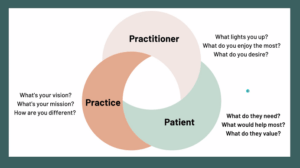
Choosing Your Digital Program Model: The 3 P’s (Patients, Practitioner, Practice)
When it comes to choosing the right program model for your practice, it’s not about following the best strategy or the latest trend, but rather finding the model that best aligns with your goals, vision, mission, the needs of your clients and practice.
To help provide some clarity, get out your notebook, or your reMarkable, or your preferred digital tool to answer the questions listed in the chart below ⬇️
You are not done yet. Just a couple more questions to dive a little deeper…
Your ‘WHY’?
- Why build a digital program for your health practice?
*greater reach & impact, work-life balance, freedom in time & money, more time with family, burnt out, entering retirement, travel more, work less, progressing with the times…all of the above?
Where do you want to be in three years?
- What kind of monthly income or annual salary do you want?
- How many days of the week do you want to work?
- What hours do you want to work?
- Will you still be working with one-to-one clients?
- Will you have more ‘free time’ and what will you do with that free time?
It’s really important to be as precise as possible, as it will help you make decisions TODAY for the FUTURE. It’s kinda like your health practice vision board, helping you get into alignment.
Look at the marketplace. What’s needed?
- What’s out there already (and of course there’s lots out there)?
- What does the market need?
- Is it saturated? No. It’s never saturated.
- Where is the gap?
The ‘Right’ Online Digital Model for the Health Industry
These models have been developed based on our clients’ real-world successes and experiences. Each model has its own strengths and advantages. As a reminder, it’s important to consider your: vision, mission, your expertise, what do the beautiful humans that you want to serve need, and the desired level of engagement that you want to provide.
Here’s the beautiful thing, my healthcare friends. I’ve spent over a decade in the digital learning and marketing space, and I can assure you that there is no one-size-fits-all solution. And that’s what makes it fun. The right model is the model that feels right for you.
The 4 Proven Online Program Models
Okay, so let’s just jump right in and break down the ‘4 Proven Models’:
1. High Touch Hybrid
- ‘High Touch Hybrid’: one-to-one appointments weekly, bi-weekly or monthly. Recorded online education (bite size). We’re going to stop repeating ourselves by recording all of our education and putting it on the internet! Downloadable resources and exercises. An online community for peer-to-peer connection. Plus, other optional features like office hours, email support or guest experts.*This model is ideal for health professionals who enjoy working closely with individuals, but also want to scale their practice.
2. Small Group
- ‘Small Group Cohort’: Live facilitated discussions (weekly or bi-weekly). Ideal number in the group is five to ten, but it can be up to 25, like my Advisory Program. The limit to the number of participants is intended for higher-touch coach access during coaching calls. Maximum online education (bite size). Downloadable resources and exercises. An online community for peer-to-peer connection and facilitated posts.*This model focuses on creating a tight-knit community of like-minded individuals, who go through a program together. It fosters collaboration, shared experiences, and peer support. If you value the power of community and want to facilitate connections among your clients, the small group cohort model may be the perfect fit.
3. Group Program
- ‘Group Program’: Recorded and/or live online education (bite size). Group office hours to ask questions. Email support and submissions for feedback. An online community for peer-to-peer connections. Other optional features like live sessions, accountability or guest experts.*The model is designed for practitioners who want to reach a larger audience and make a bigger impact. You can share your expertise with a broader audience, while still providing valuable support and guidance. If you’re eager to expand your reach and help more people, the group program model might be your ideal choice.
4. Maintenance
- ‘Maintenance Membership’/’Membership Model’: Offered after someone gets their initial results from working with you in a program or one-to-one. Recorded or live teaching or classes. Practitioner office hours. Multidisciplinary team members or guest experts. Email support. Community.*This model offers continuous support, education, and resources to members that still want to have access to you. But they don’t need weekly support, but they do need accountability, engagement and motivation to maintain their results. If you enjoy building long-term relationships with your clients and tracking long-term results, this could be your match.
Okay, at this point, we have assessed the 3 P’s section: Patients, Practitioner, Practice and we have discussed the ‘4 Proven Online Programming Models’. I am hoping that the wheels are spinning for which model you would like to try out or feel would be ideal.
Now for those of you who’s minds have potentially moved towards the worst case scenario with ‘what if nobody buys my digital program or course’? Don’t you worry. I’ve got the answers for you, but not in today’s convos.
Additional Digital Program Options
Before we conclude on the different digital programming styles, there is another style of program. I don’t really call it an online program. There are ‘Live Actionable Models’, where members get one-to-one support, not in a call, but it might be feedback via email or in a Facebook group or whatever.
Self-Studies can also be done. But, they don’t have access to you. They can’t submit questions via email. There’s no community. It’s like a book on the internet, right? Buy this course, watch the videos, download the handouts, you’re good. Those are usually lower price points, right? Those can also be really functional for practices.
Now, my recommendation to you is that you actually don’t start with a self-study because you need to test, gain feedback, and validate results before marketing to the public. If you have an idea for a self-study, you can build it out and add in a group element to test first and convert to self-study when you have ironed out the details.
Whether you’re just starting or looking to refine your current digital program, I am hoping this conversation has added some valuable insight and guidance. With the right program model, that you choose that is right for you, you can leverage your expertise to create a successful, sustainable health practice. A health practice that requires less of you and your time, meanwhile, still making a meaningful impact on the lives of many more beautiful humans.
Curious to learn more? I have included a guide to help you assess the benefits of developing an online program, course or membership for your health practice.
For practitioners who are still feeling overwhelmed or unsure about selecting their program model, or would like to gather more insight, I would LOVE to see you at one of our upcoming live webinars and workshops, where we discuss our ‘4 Proven Models’ in more detail, along with how to offer, market, and sell your group health programs and courses to indulge in more freedom, time and money.
Time to take action. Your right online program model is waiting for you.
Sending you much love, joy and happiness,
Stephanie